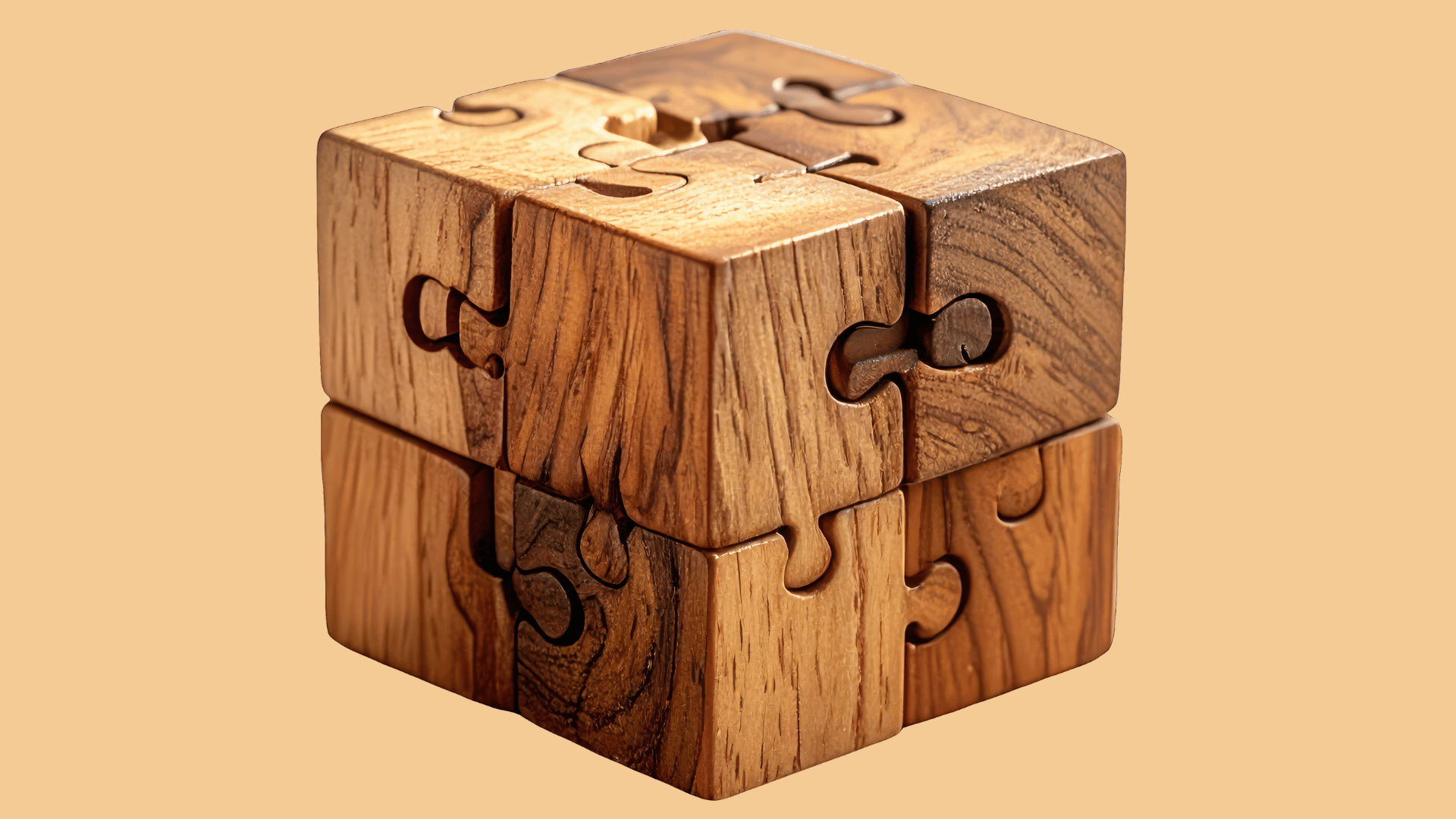
A good mechanical puzzle gives you a problem to solve. A great one gives you a reason to keep it long after you know the solution.
That difference matters to collectors.
The best mechanical puzzles for collectors combine clever mechanisms, strong craftsmanship, and a memorable solving experience. Some are tiny metal objects built around a single brilliant movement. Others are handcrafted wooden boxes hiding secret mechanisms. A few look more like kinetic sculptures than puzzles.
Instead of ranking puzzles only by difficulty, this guide looks at what each puzzle adds to a collection. After all, owning twenty nearly identical disentanglement puzzles is technically a collection, but so is keeping every takeaway menu in your kitchen drawer.
What Makes a Mechanical Puzzle Worth Collecting?
Before buying another object designed to question your intelligence, consider why some mechanical puzzles deserve permanent shelf space.
A Distinct Mechanical Idea
Mechanical puzzles are generally identified by the physical challenge involved, including opening, interlocking, disentanglement, packing, and sequential movement. The Puzzle Museum’s mechanical puzzle classification provides a deeper look at how puzzle mechanisms can be categorized.
For collectors, variety matters. A hidden maze should feel different from a burr puzzle, and a secret-opening box should create a different experience from a metal disentanglement puzzle.
Craftsmanship and Materials
Precision matters in a mechanical puzzle. A gap that is slightly too wide can reveal a secret. A wooden piece that expands can make a puzzle difficult for entirely the wrong reason.
Materials also shape the collecting experience. Brass develops character. Cast metal feels substantial. Carefully selected hardwood can turn an interlocking puzzle into a display object.
Designer, Edition, and Collector Appeal
Collectors often pay attention to the puzzle’s designer, manufacturer, edition, and production history.
Some specialist puzzle makers produce signed, dated, or limited quantities. For example, Cubic Dissection has documented puzzles released in numbered production quantities and made from selected hardwoods.
For a serious collection, knowing who designed the mechanism can be just as interesting as solving it.
Best Mechanical Puzzles for Collectors at a Glance
Mechanical Puzzle | Puzzle Type | Best For | Collector Appeal |
Hanayama Cast Enigma | Metal disentanglement | New collectors | Compact, established series |
Karakuri Puzzle Box | Secret-opening box | Craft collectors | Artisan woodworking |
REVOMAZE | Hidden maze | Expert solvers | Precision mechanism |
iDventure Cluebox | Sequential puzzle box | Experience seekers | Multi-stage solving |
Limited-Edition Burr | Interlocking | Serious collectors | Designer and wood appeal |
Tavern Puzzle | Disentanglement | Traditional puzzle fans | Handcrafted metalwork |
UGEARS Model | Mechanical build | Display collectors | Visible moving mechanisms |
Constantin-Style Puzzle | Movement/assembly | Design lovers | Creative visual mechanisms |
1. Hanayama Cast Enigma: Best Metal Puzzle for a Starter Collection
The Hanayama Huzzle collection is one of the easiest places to start exploring collectible metal mechanical puzzles.
Hanayama organizes its Huzzle puzzles from Level 1 to Level 6, with Level 6 labeled Grand Master.
For collectors, Cast Enigma is particularly interesting. Its twisted metal pieces create a surprisingly difficult disassembly and reassembly challenge. Hanayama’s official product information connects the design to a puzzle patented in the United States in 1975.
Why collectors may like it:
- Compact enough for a dedicated puzzle display
- Strong metal construction
- Recognizable puzzle series
- Challenging disassembly and reassembly goal
- Easy entry into designer-focused mechanical puzzle collecting
A Hanayama collection can also be organized by difficulty, designer, or mechanism. This gives beginner collectors a clear path instead of randomly purchasing shiny metal objects at 2 a.m.
2. Karakuri Puzzle Boxes: Best for Traditional Craftsmanship
Some mechanical puzzles hide their complexity.
A Karakuri puzzle box may look like a beautifully finished wooden object until you attempt to open it.
The Karakuri Creation Group brings together craftspeople creating original, high-quality Karakuri boxes. The group’s work includes original mechanisms and traditional-style trick boxes.
Why Puzzle Boxes Appeal to Collectors
Puzzle boxes combine several collector interests:
- Woodworking
- Secret mechanisms
- Functional storage
- Individual craftsmanship
- Display value
The solving experience is also different from a traditional brain teaser. You are not always given obvious moving pieces. The entire object must be examined for subtle mechanical clues.
For collectors interested in Japanese puzzle boxes, secret boxes, and handcrafted mechanical puzzles, Karakuri deserves serious attention.
3. REVOMAZE: Best Hidden-Maze Mechanical Puzzle
A visible maze is easy to understand.
REVOMAZE removes the convenient part where you can actually see it.
The current Puzzle Workshop REVOMAZE range uses a structured system of maze-puzzle difficulty levels.
The basic challenge involves navigating a concealed mechanical maze through controlled movement. You learn from position, movement, and mistakes rather than simply staring at a printed maze.
Best for collectors who enjoy:
- Precision-engineered mechanical puzzles
- Mapping and note-taking
- Long solving sessions
- Increasing difficulty systems
- Compact metal puzzle designs
REVOMAZE is particularly appealing when you want your collection to include a puzzle built around tactile information rather than visual clues.
4. iDventure Cluebox: Best Sequential Puzzle Experience
Traditional mechanical puzzles may revolve around one central trick. Sequential puzzles give you a chain of problems.
The iDventure Cluebox collection presents compact wooden puzzle boxes with multiple puzzles that must be solved as you work toward opening the box. The official range currently includes themes such as Schrödinger’s Cat, Captain Nemo’s Nautilus, and Cambridge Labyrinth.
These are excellent mechanical puzzles for adults who enjoy escape-room-style problem solving.
Collector appeal includes:
- Strong visual themes
- Multiple mechanical interactions
- Resettable designs
- Display-friendly wooden construction
- A longer narrative-style solving experience
A Cluebox adds something important to a mixed collection: progression. You are solving a small mechanical journey rather than one isolated movement.
5. Limited-Edition Wooden Burr Puzzles: Best for Serious Collectors
The classic burr puzzle is one of the most recognizable forms of interlocking mechanical puzzle.
However, serious collectors should look beyond basic mass-produced six-piece designs.
Specialist makers such as Cubic Dissection offer interlocking, packing, metal, and puzzle-box categories, including handcrafted collector-focused work.
Look Beyond the Classic Six-Piece Burr
When evaluating a wooden interlocking puzzle, consider:
- Designer name
- Number of moves required
- Unusual movements
- Wood selection
- Production quantity
- Whether the puzzle is signed or dated
One documented Cubic Dissection release, Stepping Burr, was produced in a quantity of 96 copies and described with its designer, materials, release date, and edition information.
That type of documentation makes a puzzle especially interesting for collectors who enjoy knowing the history behind each piece.
6. Tavern Puzzles: Best Handcrafted Metal Disentanglement Puzzles
For something with a more traditional appearance, consider Tavern Puzzles.
These handcrafted metal puzzles draw from puzzle designs traditionally associated with blacksmithing and tavern entertainment. The maker states that its puzzles are individually assembled and designed so the object piece is removed mechanically rather than through force or trickery.
Visually, they are completely different from polished cast-metal brain teasers.
That is exactly why collectors should notice them.
Why add one to your collection?
- Handcrafted appearance
- Historical puzzle influence
- Strong display character
- Durable metal construction
- Distinct disentanglement mechanisms
A balanced mechanical puzzle collection needs texture and contrast. Forged-looking steel provides plenty of both.
7. UGEARS Mechanical Models: Best Display-Worthy Builds
Not every collector wants a small puzzle hidden inside a drawer.
Some want gears. Lots of gears.
UGEARS mechanical models are self-assembled wooden mechanical builds designed for experienced builders as well as hobbyists. The company’s advanced range focuses on more detailed mechanical models and states that its kits require no glue or tools.
These models sit somewhere between 3D wooden puzzles, mechanical construction kits, and kinetic display pieces.
They are ideal for collectors who value:
- Visible gear systems
- Assembly experience
- Moving mechanisms
- Large display pieces
- Engineering-inspired designs
The solving experience is different from a secret box or hidden maze. Here, the enjoyment often comes from understanding how the mechanism develops while you build it.
8. Jean Claude Constantin-Style Puzzles: Best for Visual Mechanisms
Collectors should also make room for puzzles where the mechanism becomes part of the visual design.
Designer-focused wooden and metal brain teasers can use sliding pieces, packing restrictions, gears, and unusual geometric arrangements.
For example, Project Genius currently lists Archimedes’ Gear, a puzzle built around interlocking gears and magnetic elements.
Another example is the Waiter’s Tray puzzle, designed by Jean Claude Constantin, where pieces must be moved to release a tray.
These puzzles are useful in a collection because the mechanical concept is visually readable. Guests can often understand the goal before touching the puzzle.
Whether they can solve it is another, considerably less cheerful matter.
How to Build a Balanced Mechanical Puzzle Collection
Finding the best mechanical puzzles for collectors does not mean purchasing every difficult puzzle available.
A better collection has variety.
Collect Different Mechanisms
Try building around puzzle families:
- One metal disentanglement puzzle
- One wooden burr
- One secret-opening puzzle box
- One sequential discovery puzzle
- One hidden-maze puzzle
- One packing puzzle
- One mechanical construction model
You will quickly discover which solving style you prefer.
Buy Fewer, Better Puzzles
A shelf filled with puzzles you barely remember is not automatically better than a focused ten-piece collection.
Before purchasing, ask:
- Is the mechanism different from puzzles I own?
- Do I know the designer?
- Is the craftsmanship interesting?
- Will I display it?
- Is there a story behind the puzzle?
These questions are particularly useful when buying expensive collectible mechanical puzzles.
Record Designers and Editions
Create a simple spreadsheet with:
- Puzzle name
- Designer
- Maker
- Puzzle category
- Material
- Purchase date
- Edition information
- Solve date
- Personal difficulty rating
Collectors of nearly every other object document what they own. Puzzle collectors should probably stop relying on a mysterious cardboard box labeled “hard metal things.”
How to Store and Protect Collectible Mechanical Puzzles
Storage is especially important for precision wooden puzzles.
Follow the maker’s care recommendations. Cubic Dissection, for example, gives specific humidity guidance for some handcrafted wooden puzzles because changes in wood can affect operation.
General care tips include:
- Keep precision wooden puzzles away from extreme humidity.
- Avoid forcing stuck mechanical pieces.
- Store small removable parts together.
- Keep original documentation when possible.
- Use display stands for metal puzzles that scratch easily.
- Photograph complicated puzzles before long-term storage.
For historical inspiration, the Lilly Library’s mechanical puzzle collection also demonstrates how broad mechanical puzzle collecting can become, with hundreds of puzzles representing different periods and places.
FAQs About Mechanical Puzzles for Collectors
What Is the Best Mechanical Puzzle for a Beginner Collector?
A Hanayama Huzzle is an accessible starting point because the official range has clearly separated difficulty levels from Level 1 through Level 6.
Start with a moderate difficulty puzzle before jumping directly into the hardest category. Your dignity deserves at least a brief adjustment period.
Are Mechanical Puzzles Valuable?
Some puzzles may become desirable because of their designer, craftsmanship, small production quantity, or historical importance. However, collector appeal does not guarantee financial appreciation.
Buy puzzles because the design interests you first. Treat potential resale value as secondary.
What Is the Hardest Type of Mechanical Puzzle?
There is no single hardest category. A sequential discovery puzzle may demand observation and multi-stage reasoning, while a hidden maze tests spatial memory and mapping. High-level interlocking puzzles can involve complicated move sequences.
Difficulty depends heavily on the mechanism and the solver.
Are Wooden or Metal Mechanical Puzzles Better?
Neither material is automatically better.
Metal puzzles are often compact and durable. Wooden puzzles provide greater visual variation through different woods and can highlight artisan craftsmanship.
A serious collection can easily include both.
The Bigger Picture: Which Mechanical Puzzle Should You Collect First?
The best mechanical puzzles for collectors are not simply the puzzles with the highest difficulty rating. They are the ones that introduce an interesting mechanism, tell a design story, or represent a type of puzzle missing from your collection.
Start with Hanayama Cast Enigma if you want a compact metal challenge. Explore Karakuri puzzle boxes for craftsmanship, REVOMAZE for hidden-maze solving, or a limited-edition burr puzzle when designer and production details matter.
For a more balanced collection, stop thinking only about which puzzle is hardest.
Collect mechanisms.
Collect designers.
Collect puzzles that make you turn them over in your hands and wonder how anyone designed the ridiculous thing in the first place.
That is where mechanical puzzle collecting becomes far more interesting than simply solving the next brain teaser.