An HVAC technician can own dozens of tools and still waste time walking back to the service truck for the one tool actually needed.
That is why building a good HVAC toolkit is not about buying everything. It is about carrying the right tools for the job.
The must-have HVAC tools for electrical diagnosis are different from those used for refrigerant service, airflow testing, or system installation. Beginners also do not need every expensive specialty tool on day one.
This guide breaks down the most important HVAC tools by job type and shows you how to organize them into a practical daily service bag, diagnostic bag, and service truck setup.
Quick List of Must-Have HVAC Tools
HVAC Tool | Main Use | Where to Keep It |
Multimeter | Electrical diagnosis | Daily bag |
Clamp meter | Current measurement | Daily bag |
Screwdriver set | Panels and components | Daily bag |
Nut drivers | HVAC fasteners | Daily bag |
Pliers | Gripping and cutting | Daily bag |
Wire strippers | Electrical wiring | Daily bag |
Adjustable wrench | Fittings | Daily bag |
Tape measure | Installation measurements | Daily bag |
Flashlight | Dark work areas | Daily bag |
Manifold gauges | Refrigerant diagnosis | Diagnostic bag |
Micron gauge | Vacuum measurement | Diagnostic bag |
Leak detector | Refrigerant leaks | Diagnostic bag |
Manometer | Pressure testing | Diagnostic bag |
Vacuum pump | System evacuation | Service truck |
Refrigerant scale | Charging and recovery | Service truck |
Must-Have HVAC Hand Tools for Everyday Service Calls
Your daily tool bag should contain equipment you use on most service calls.
-
HVAC Screwdriver and Nut Driver Set
HVAC systems contain panels, electrical compartments, and components secured by several types of screws and hex-head fasteners.
A good set should include:
- Phillips screwdrivers
- Flathead screwdrivers
- Magnetic nut drivers
- Multi-bit HVAC drivers
A magnetic nut driver is especially useful inside equipment cabinets. Dropping a screw into a unit can turn a simple job into an unwanted treasure hunt.
-
Pliers
Most technicians carry several types of pliers.
Lineman’s pliers are useful for gripping, twisting, and cutting wire.
Needle-nose pliers help when working with small wires or tight electrical compartments.
Tongue-and-groove pliers grip larger fittings and components.
Diagonal cutters are useful for cutting wires and cable ties.
These are some of the most frequently used HVAC hand tools.
-
Wire Strippers and Crimpers
HVAC systems contain thermostat wires, control wiring, motors, relays, and electrical connections.
Wire strippers remove insulation without damaging the conductor.
A combination stripper and crimper can:
- Strip different wire sizes
- Cut wire
- Crimp electrical connectors
For service technicians, this tool deserves a permanent place in the daily bag.
-
Adjustable Wrench
Adjustable wrenches are useful for fittings and mechanical connections.
Many HVAC technicians carry two.
One wrench can hold a fitting while the second turns the connection. This helps reduce unnecessary twisting or stress on tubing and components.
-
Tape Measure
Technicians use tape measures for:
- Equipment dimensions
- Duct openings
- Installation clearances
- Line-set distances
- Mounting locations
Simple tool. Constantly useful. Humans occasionally invent things correctly.
-
Flashlight or Headlamp
HVAC equipment has an impressive ability to end up in dark attics, crawlspaces, and mechanical rooms.
A rechargeable flashlight is essential.
A headlamp is also useful because it keeps both hands free.
Many technicians carry both.
Must-Have HVAC Tools for Electrical Diagnosis
Electrical issues are common in compressors, blower motors, capacitors, contactors, relays, thermostats, and control boards.
Accurate electrical tools help technicians identify the actual problem before replacing expensive components.
-
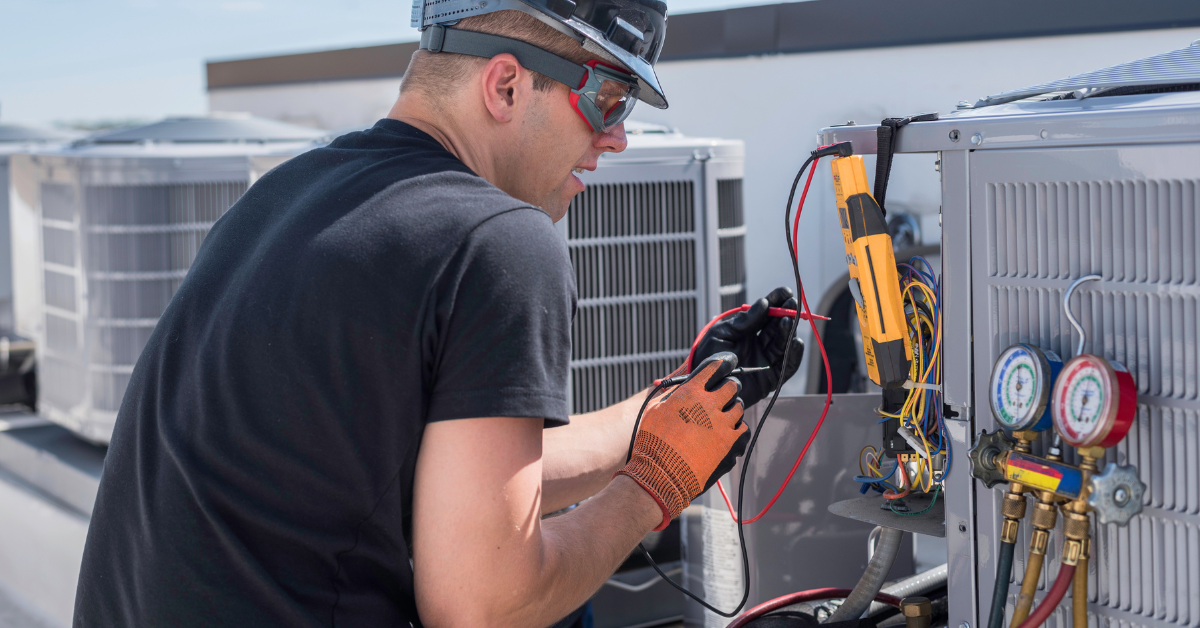
HVAC Multimeter
A multimeter is one of the most important HVAC diagnostic tools.
Depending on the model, it can measure:
- AC and DC voltage
- Resistance
- Continuity
- Capacitance
- Temperature
Capacitance testing is especially useful when checking HVAC capacitors.
What Should You Look for in an HVAC Multimeter?
Consider:
- True RMS measurement
- Capacitance testing
- Temperature capability
- Clear display
- Appropriate safety ratings
- Durable test leads
Accurate measurements matter. Replacing a compressor because of a bad diagnosis is more expensive than buying a reliable meter.
-
Clamp Meter
A clamp meter measures electrical current around a conductor.
It is useful for testing:
- Compressor current
- Blower motors
- Condenser fan motors
- Electrical loads
Multimeter vs Clamp Meter
A multimeter is mainly used for voltage, resistance, continuity, and capacitance.
A clamp meter is especially useful for current measurement.
Many professional technicians carry both.
-
Non-Contact Voltage Tester
A non-contact voltage tester provides a quick indication that voltage may be present.
It is convenient for an initial check but should not replace a proper electrical meter.
Think of it as a screening tool, not a complete diagnosis.
-
Insulated Electrical Hand Tools
Insulated screwdrivers and pliers can provide extra protection during appropriate electrical work.
Technicians must still follow proper safety procedures.
A tool marked “insulated” does not make electricity suddenly reasonable.
Must-Have HVAC Tools for Refrigerant Service
Refrigerant work requires specialized tools for measuring pressure, evacuating systems, detecting leaks, and handling refrigerant.
-
Manifold Gauge Set
Manifold gauges help technicians evaluate system pressures and perform refrigerant diagnosis.
Analog Manifold Gauges
Advantages include:
- Simple operation
- Lower cost
- Familiar design
Digital Manifold Gauges
Depending on the model, digital gauges may display:
- Pressure
- Temperature
- Superheat
- Subcooling
- Refrigerant profiles
Digital gauges provide more information, while analog gauges offer simplicity.
The best option depends on your work and budget.
-
Vacuum Pump
A vacuum pump helps remove air and moisture from a refrigerant system before charging or returning it to operation.
It is essential for many installations and major repairs.
However, it is not a daily carry tool.
Keep it in the service truck and bring it out when needed. Your back did nothing to deserve carrying a vacuum pump through every customer’s house.
-
Micron Gauge
A micron gauge measures deep vacuum.
Technicians use it to verify evacuation conditions.
A manifold gauge showing vacuum does not provide the same level of measurement as a dedicated micron gauge.
For refrigeration work, this is an important tool.
-
Refrigerant Scale
A refrigerant scale measures refrigerant by weight.
It is commonly used during:
- Charging
- Recovery
- Refrigerant transfer
A reliable scale helps technicians track how much refrigerant enters or leaves a system.
-
Electronic Refrigerant Leak Detector
Refrigerant leaks may occur around:
- Coils
- Fittings
- Valves
- Brazed joints
- Line sets
An electronic leak detector helps technicians locate possible leaks.
Other methods include bubble solution and UV dye.
An electronic detector is useful for searching. Bubble solution can help confirm leaks at accessible points. UV dye may be used for certain system-specific investigations.
-
Refrigerant Recovery Machine
A recovery machine removes refrigerant from a system and transfers it into suitable recovery equipment.
This is normally service truck equipment rather than a daily carry tool.
Technicians performing refrigerant repairs regularly will use recovery equipment frequently.
-
Core Removal Tool
Core removal tools are used when working with valve cores and refrigerant system access points.
Depending on the procedure, they may also help during system evacuation.
It is a small tool with significant value during refrigeration service.
HVAC Diagnostic Tools for Airflow and Temperature Problems
Not every cooling complaint is caused by refrigerant.
Low airflow, dirty filters, duct restrictions, blower problems, pressure issues, and humidity can all affect system performance.
-
Digital Temperature Probe
Temperature probes can measure:
- Return-air temperature
- Supply-air temperature
- Refrigerant line temperature
- Outdoor temperature
Accurate temperature readings should form part of a broader diagnosis.
Touching a pipe and saying “it feels cold” remains scientifically underwhelming.
-
Psychrometer
A psychrometer measures air conditions such as:
- Dry-bulb temperature
- Wet-bulb temperature
- Relative humidity
It can be valuable when investigating comfort complaints, cooling performance, or humidity problems.
-
Manometer
A manometer measures pressure.
In HVAC work, it is commonly used for measurements such as static pressure when appropriate for the instrument and application.
Static pressure testing can help identify possible airflow restrictions, including:
- Dirty filters
- Restrictive ductwork
- Closed dampers
- Coil restrictions
Airflow problems can sometimes appear similar to refrigeration issues. A manometer provides actual data instead of assumptions.
-
Anemometer
An anemometer measures air velocity.
Technicians may use it to investigate airflow at supply outlets and compare air movement in different parts of a building.
It should be used as part of a broader airflow evaluation.
-
Infrared Thermometer or Thermal Camera
Infrared tools allow technicians to inspect surface temperatures quickly.
An infrared thermometer measures a selected area.
A thermal camera displays temperature patterns across a larger surface.
Thermal cameras provide more visual information, but they do not replace proper electrical, airflow, or refrigeration testing.
Must-Have HVAC Tools for Installation and Repair
Installation technicians need tools for drilling, cutting, shaping tubing, and working with sheet metal.
-
Cordless Drill or Impact Driver
These tools are used for:
- Removing panels
- Installing fasteners
- Mounting equipment
- Drilling holes
- General installation work
A drill provides controlled drilling and fastening.
An impact driver is particularly useful for driving fasteners.
Many technicians carry both.
-
Tubing Cutter
Tubing cutters create clean cuts in copper tubing.
Compact cutters are useful in tight spaces.
Technicians working with refrigerant lines may need several sizes.
- Flaring Tool
Flaring tools create flared tubing connections.
They are commonly used on equipment with flare fittings, including many ductless systems.
A poorly made flare can contribute to leaks, so tool quality and proper technique matter.
-
Swaging Tool
A swaging tool expands the end of tubing so another tube can fit inside it in suitable applications.
Flaring creates a connection for a flare fitting.
Swaging expands tubing.
They are different processes and require different tools.
-
Tubing Bender
Tubing benders help shape tubing while reducing the risk of kinks.
They are especially useful when routing refrigerant lines through tight installation areas.
Clean line-set routing also makes future service easier.
Future technicians may not know your name, but they will absolutely judge your tubing work.
-
Tin Snips
Tin snips are used for cutting sheet metal.
Common types include:
- Left-cut snips
- Right-cut snips
- Straight-cut snips
Different types are designed to make cuts in different directions.
Technicians working with ductwork should keep a complete set available.
-
Sheet Metal Crimper and Seamer
A crimper can help shape sheet metal connections.
A hand seamer helps bend and form sheet metal.
These tools are especially useful for technicians who install or modify ductwork.
-
Brazing Equipment
A professional brazing setup may include:
- Torch equipment
- Regulators
- Brazing materials
- Nitrogen equipment
- Heat protection accessories
- Fire safety equipment
Brazing should always be performed using appropriate professional procedures and safety practices.
Technicians should follow manufacturer requirements and applicable standards.
HVAC Safety Tools You Should Never Leave Behind
Tools are replaceable.
Eyes, ears, hands, and feet are considerably more difficult to replace.
-
Personal Protective Equipment
HVAC safety equipment may include:
- Safety glasses
- Work gloves
- Appropriate footwear
- Hearing protection
- Respiratory protection when required
- Knee protection
The correct personal protective equipment depends on the work and environment.
Safety gear should match actual hazards, not spend its entire career buried under old fittings in the bottom of a tool bag.
The HVAC 3-Bag System: A Smarter Way to Organize Tools
A simple way to organize HVAC tools is to separate everyday equipment from diagnostic and heavy tools.
Bag 1: Daily Service Bag
Consider carrying:
- Multimeter
- Clamp meter
- Multi-bit screwdriver
- Nut drivers
- Pliers
- Wire strippers
- Adjustable wrench
- Tape measure
- Flashlight
- Temperature probes
This bag should handle initial inspection and common service work.
Bag 2: HVAC Diagnostic Bag
Keep specialized instruments together, including:
- Manifold gauge set
- Refrigerant leak detector
- Psychrometer
- Manometer
- Anemometer
- Additional temperature probes
Bring this bag when deeper diagnosis is required.
Service Truck Tools
Larger tools can remain in the vehicle:
- Vacuum pump
- Recovery machine
- Refrigerant scale
- Brazing equipment
- Power tools
- Sheet metal tools
- Installation equipment
Match your tools to the service call.
There is no reason to carry every tool you own through a customer’s house because one thermostat stopped working.
Must-Have HVAC Tools for Beginners
New technicians should build their tool collection in stages.
Buy These HVAC Tools First
Start with:
- Multimeter
- Screwdrivers
- Nut drivers
- Pliers
- Wire strippers
- Adjustable wrench
- Tape measure
- Flashlight
- Basic temperature tools
These tools create a strong beginner HVAC toolkit.
Add Diagnostic Tools as Your Skills Grow
Next, consider:
- Clamp meter
- Manifold gauges
- Leak detector
- Manometer
- Psychrometer
- Tubing tools
Choose tools based on the systems you actually service.
Buy Specialty Tools When the Job Requires Them
Specialty equipment may include:
- Vacuum pumps
- Recovery machines
- Digital manifold systems
- Thermal cameras
- Advanced testing equipment
Some employers provide large or expensive equipment.
Check what your company supplies before spending heavily.
Which HVAC Tools Are Worth Spending More On?
Spend carefully on tools used every day, including:
- Pliers
- Screwdrivers
- Wire strippers
- Electrical meters
- Tool bags
Accuracy is especially important for:
- Multimeters
- Clamp meters
- Manifold gauges
- Micron gauges
- Refrigerant scales
- Temperature instruments
HVAC diagnosis depends on measurements.
If the measurement is wrong, the diagnosis may also be wrong.
You may be able to delay buying tools designed for systems you rarely service or equipment already supplied by your employer.
Common HVAC Tool Buying Mistakes
Buying Every Tool Immediately
Beginners rarely need every specialty tool on day one.
Start with daily tools and expand as your responsibilities grow.
Choosing Price Over Accuracy
Cheap hand tools may be annoying.
Inaccurate diagnostic tools can create expensive mistakes.
Carrying Too Many Tools
More tools do not always mean better preparation.
Sometimes they simply mean a heavier tool bag.
Ignoring Tool Compatibility
Check equipment and tool specifications before working with unfamiliar systems or refrigerants.
Never guess compatibility.
Failing to Maintain Diagnostic Tools
Regularly:
- Check batteries
- Inspect test leads
- Clean sensors
- Inspect hoses
- Follow calibration recommendations
A diagnostic tool is only useful when it works correctly.
Frequently Asked Questions About HVAC Tools
What are the must-have HVAC tools for a technician?
Essential HVAC tools include a multimeter, clamp meter, screwdrivers, nut drivers, pliers, wire strippers, adjustable wrench, flashlight, temperature probes, manifold gauges, leak detector, and suitable safety equipment.
What HVAC tools should a beginner buy first?
Beginners should start with a multimeter, screwdriver set, nut drivers, pliers, wire strippers, adjustable wrench, tape measure, flashlight, and temperature tools.
What tools do HVAC technicians use every day?
Common daily tools include electrical meters, screwdrivers, nut drivers, pliers, wire strippers, wrenches, flashlights, and temperature probes.
What diagnostic tools do HVAC technicians need?
Common HVAC diagnostic tools include multimeters, clamp meters, manifold gauges, temperature probes, psychrometers, manometers, leak detectors, and anemometers.
What HVAC tools should stay in the service truck?
Vacuum pumps, refrigerant recovery machines, refrigerant scales, brazing equipment, large power tools, and sheet metal tools can usually remain in the service truck until needed.